The Neurodiagnostic Niche
Encouraging a community in the world of Neurodiagnostics
Seizure Classification Quick Tip

“Let perseverance be your engine and hope your fuel.” – H. Jackson Brown, Jr.
Wrapping up our series of Fall Quick Tips – this post’s ‘focus’ (get it? : ) is Seizure Classification.
Seizure Classification… Clinical Manifestations…Syndromes, etc…are all on the Content Outline of the Exam.
Being proficient in this area is not just for board prep but is also essential in our the daily patient care responsibilities.
For this topic I am going to point you to a website that summarizes this very well – it’s an Epilepsy online diagnostic manual called EpilepsyDiagnosis.org (you’ll also find this Quick Tip and more helpful links on the Neurodiagnostic Niche’s Resource Library).
It’s super user friendly…it’s comprehensive list of the epilepsies with detailed descriptions and some videos make this a great place to start.
You’ll find most all you need to know here.
If you find your self-studying approach could use a coach or tutor to keep you on track – just email me @ RTompkins@TompkinsAssociates.com
This post wraps up our Fall Quick Tips series – Stay tuned and be sure to put in your email address at the bottom of this web page to receive posts directly to your inbox.
We’ll resume at the top of the New Year!
But before we wind down 2021 – let’s take a moment to reflect back…
- Did we accomplish what we had hoped to this year?
- Were our goals within reach and did we do the work?
- Was this Your Year to Getting Registered?
If so and if I can help in any way – just let me know!
Let’s Stay Curious and Grow What We Know
North Texas Neurodiagnostic Academy – Currently Enrolling
MVAP for all your supply needs
Normal Variants Quick Tip
“Things are seldom what they seem.” – W.S. Gilbert
Continuing with our Fall Quick Tips Series: What is a normal variant in an EEG?
Waves that are rare or unusual but not generally abnormal…
They are odd looking….they may be unusual in shape or in distribution…These variant waveforms are rare or unusual but are known to be generally benign. But that doesn’t mean they are not still interesting!
- My favorite is the Mu Rhythm – I think it’s super interesting because of it’s relation to the Homunculus Man and it’s reactivity if you ask the patient to squeeze their fist or if you even touch their hand. The mu waveform, if it appears, occurs in the central regions in the awake patient…best seen with their eyes open. It’s often in the alpha range and can be asymmetrical.
- A close second favorite of mine are Lambda Waves – Lambda waves occur in the occipital regions bilaterally as positive (upward) waves. They are triangular in shape and generally symmetric. They are most often seen when a patient is visually scanning something; such as, when they read.
Other normal variants include:
- Wicket Spikes
- SREDA (Subclinical Rhythmic EEG Discharges in Adults)
- RMTD (Rhythmic Mid-Temporal Theta of Drowsiness)
- BETS (Benign Epileptiform Transients of Sleep)
- 14 and 6 Positive Spikes
- and there are more…
It’s a great area to review and become familiar with – many of these are really interesting and often mistakenly referred to as abnormal.
For more resources:
- Visit The Marketplace on this site and look for the Waveform Notecards
- Interested in tutoring or training Zoom lessons? Just email me @ RTompkins@TompkinsAssociates.com
Just remember:
What we are recording is the electrical activity of a highly complex system – so a variation is to be expected…occasional atypical waveforms that still fall within what would be considered normal is likely.
Let’s Stay Curious and Grow What We Know
Filters Quick Tip
“Without a Filter, man is just chaos walking.” – Patrick Ness
EEG is no different than the quote above…our recordings would be chaos without them.
In simple terms:
a filter is a device or process that removes some unwanted components or features from a signal.
Mental Note: 30%
Thats the % to remember when asked about filters…
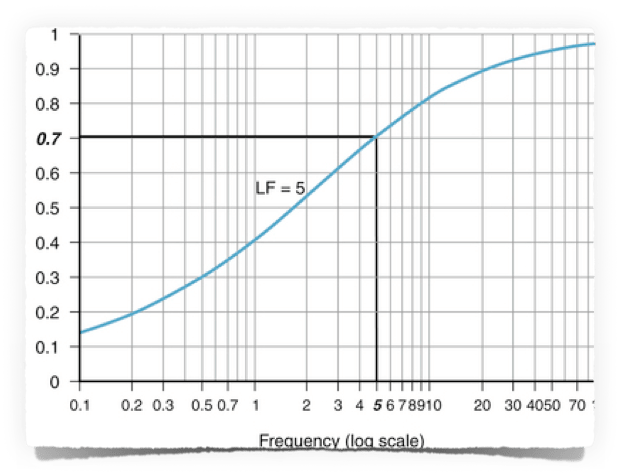
When a low-frequency filter encounters a sine wave that happens to be exactly at its cutoff frequency, it cuts down the amplitude of that wave by approximately 30%.
So since for EEG our LFF (low frequency filter) is 1 Hz – the amplitude of a 1 Hz will be reduced by 30%.
Key Point to Note:
Waves at frequencies below the LFF are reduced by somewhat more than 30%—Also, waves at frequencies somewhat above the LFF are also reduced in size, but by less than 30%.
So its more like a roll off than a cut-off.
See graph below:
The same is true on the other end of the range…when talking about the HFF (high frequency filter):
Since our HFF is 70 Hz – the amplitude of a 70 Hz will be reduced by 30%.
But this time:
Waves at frequencies higher than the HFF are reduced by somewhat more than 30%—and waves at frequencies somewhat slower than the cutoff frequency are also reduced in size by the filter, but by less than 30%.
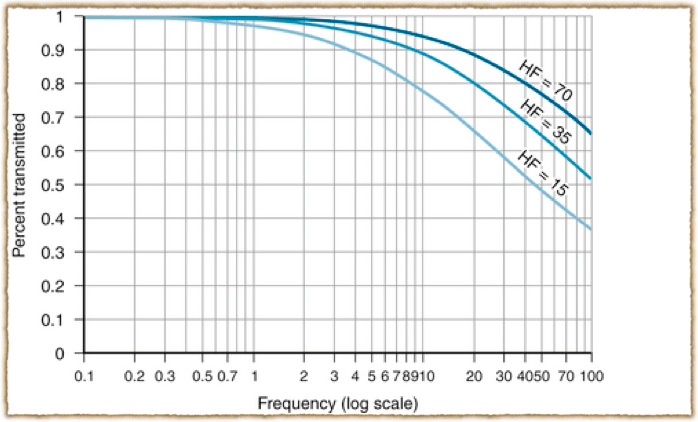
Understanding filters is key to understanding what you are looking at on the tracing…it is also important to understand how your use of filters can alter the display.
Need additional help preparing for your boards? Check out the Resource Library on this site….or just email me at RTompkins@TompkinsAssociates.com.
Lets Stay Curious and Grow What We Know
North Texas Neurodiagnostic Academy
Enrolling Now for January 2022 Start Date
Polarity Quick Tip
“Be Positive! Negativity doesn’t get you anywhere.” – Peter W. Murphy
First in the series of Fall Quick tips: Polarity
If Input 1 is more Negative than Input 2, there will be an Upward deflection.
Opposite of what you might think of Positive and Negative…the Reverse is True.
Quick Examples:
- If input 1 is 3 mV and input 2 is 5 mV – the deflection will be Upward.
- If input 1 is 8 mV and input 2 is 5 mV – the deflection will be Downward.
- If input 1 is 50 mV and input 2 is 80 mV – the deflection will be Upward.
- If input 1 is 30 mV and input 2 is 30 mV – the deflection will be Canceled Out.
Just Remember:
The Deflection = Input 1 – Input 2
and
An upward deflection is surface negative, and a downward deflection is surface positive.
Interested in receiving Quick Tips straight to your Inbox? Scroll to the bottom of this page and just enter your address.
Need additional help? Just email me @ RTompkins@TompkinsAssociates.com
Let’s Stay Curious and Grow What We Know
Here We Go Again

“When we are no longer able to change a situation. We are challenged to change ourselves.” – Viktor Frankl (p.s. an Austrian Neurologist)
Does it feel a little like deja vu to you too? Life circumstances out of our control and uncertainty being more the norm…
Let’s focus on what we CAN control.
Our attitude…..Our outlook….Our goals
This year is proof – that the more things change…the more things stay the same. What’s the other saying? What goes around comes around…
Even though life doesn’t come with a road map – we do have choices and there are many things well within our control.
For those of us in Neurodiagnostics I can say for sure: If you take the time to get registered in this field – You will hands down improve your circumstances.
Your pay…..your job offers….your over-all career
Next week starts my Fall Challenge:
Whether you are nearing the end of Your Year to Getting Registered or somewhere stuck in the middle – Tune in for tips/suggestions/and reminders to get you on your way.
Tip #1 though – if you know yourself and you need a structured program to take you from A to Z, email me at RTompkins@TompkinsAssociates.com
My 30 week training program starts it’s Fall session next week (both in person and remote options available). Find out how you can join.
Let’s Stay Curious and Grow What We Know
The 2nd Half

“The Second Half is a Whole New Ballgame…” – Ahman Green
Well it’s August and we are well into 2021’s 2nd half – Maybe now is the time for a quick check up on all you had hoped for this year.
Remember back to January…. those days where you resolved to get organized/healthy/_______(you fill in the blank).
Well…it’s not too late.
How about your career goals? Still wanting to expand your skill set? How about your pay?
If this was your Year to Getting Registered – it’s not too late!
Click here to see the 4 Pathway options to taking the board exam.
Click here to see where the measurement assessments are happening this Fall.
Click here to work on accumulating those CEU’s.
Also, don’t forget to check out the complimentary Resource Library on this site.
Need additional tutoring support as you work towards preparing?
Just email me and we can get a session or two on the calendar (RTompkins@TompkinsAssociates.com).
Or if you are looking for a more comprehensive training program that will take you from A to Z on your board prep: Click here to visit my training site – North Texas Neurodiagnostic Academy (www.NorthTexasNeurodiagnosticAcademy.com). The Fall Semester starts this month: offering both in person and remote learning opportunities with flexible scheduling to allow your training to fit into your already busy schedule.
The goal is working towards and achieving what you set out to do this year – it’s time to work on having that successful 2nd half!
Let’s Stay Curious and Grow What We Know
California Dreaming

“The cure for boredom is curiosity. There is no cure for curiosity” – Dorothy Parker
So continuing with our Summer of Education opportunities the blog would be missing out if it didn’t dedicate a post to the upcoming ASET conference in August.
First off – Why go?
The reasons are many…here are just a few:
Networking – it’s a great way to meet like minded people with similar career interests. Getting to know your industry peers gives you the opportunity to expand your network and connections as well as learning from others.
CEUs – whether you are planning to sit for your boards or renew them….we all need them.
and third – it’s in San Diego!
I recall many years ago when I first entered into the field attending these conferences…It helped solidify my interest, expanded my knowledge base, increased my connections and really helped confirm for me why I love working in Neurodiagnostics.
Whether you need CEUs or just need a jump start to your career – check out the conference link below. There is also a virtual opportunity too if flying to California is not an option:
Let’s Stay Curious and Grow What We Know
The (Not So) Lazy Days of Summer

“He who laughs most, learns best.” – John Cleese
This summer on the blog is all about Continuing Education…we all know learning should be a lifelong process, and devoting time to it can be a journey of both our personal and professional development.
Whether you want to learn more about a subject that you find interesting or want some additional skills to take to your work, there are ways you can use continuing education to your advantage.
Earning CEU’s is a bonus (especially when you need them to renew your certification) but they shouldn’t be our only reason for seeking out a course or webinar.
Learning for the sake of learning is always the best motivator and what we gain from that is always far more valuable than a CEU.
The list below is designed to help you get started or for those already knee deep in the process – you might find a few new resources:
- Natus Neuro Training (click here for the talk I did for them)
- Harvard’s On-Line Neuroscience Courses (3 Free Ones)
- edX Courses (more free)
Interested in additional Neurodiagnostic support as you prep for your boards or interested in a full training academy program to take you from A to Z….Just email me @ RTompkins@TompkinsAssociates.com
Let’s Stay Curious and Grow What We Know
Summer Discounts

New Summer Discounts!
Check out the Summer-Scholar Option – take advantage of bundle savings with Notecards, Study Guides and Training Options.
Just visit the Marketplace today: (Click Here for Summer Savings Option)
Worth Your Time

“The capacity to learn is a gift; the ability to learn is a skill; the willingness to learn is a choice.” – Brian Herbert
This Summer’s focus on the blog is all about Continuing Education – Some of us do this because it’s required to gain CEU’s for our re-certification and then there are some of us that do this just because the benefits are many.
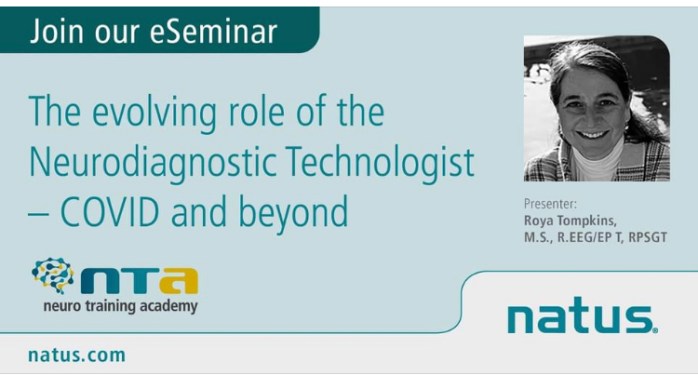
Wherever you are in the above sentence – I would encourage you to mark your calendar for Thursday, June 17th @ 11am EST to hear the upcoming eSeminar from Natus’ Training Academy.
It’s entitled: ‘All the Wiggly Lines: In-office and Ambulatory EEGs in Private Practice’ and the presenter is Dr. Daniel Gossett.
Not only because it will be an informative educational hour but because he is one of the doctors I work for and I can assure you it will be well worth your time.
As technicians and technologists let’s be sure to prioritize Continuing Education as part of our regular workday….hence the closer below for every blog post : )
Let’s Stay Curious and Grow What We Know

Registered Technologist | Business Owner | Encourager of a community helping others find their way in the world of Neurodiagnostics.
Business website: www.TompkinsAssociates.com
Blog: NeurodiagnosticNiche.com Training Academy: North Texas Neurodiagnostic Academy
 The Neurodiagnostic Niche